
Most people understand the broad idea of diversification: don’t put all your money in one place.
What’s often missed is, where does your risk sit.
Picture this, a couple about five years from retirement. They own their home and an investment property. They have shares in the four major Australian banks, an Australian dividend fund and separate super funds.
On paper, that looks well spread.
Look underneath, though, and much of their financial position depends on the same investment mix; in their case, Australian property, banks, interest rates and the local economy.
They own several investments across several accounts. But many of those investments respond to the same events. In this case, what’s happening in Australia.
That’s the difference between looking diversified and being diversified.
Diversification isn’t about how many investments you own. It’s about understanding how much of the same risk you own.
The same $10,000 invested four different ways
To see how diversification works in practice, the Lonsec analysis follows the same $10,000 across four investment options: Australian fixed interest, AustralianSuper MySuper Balanced, international shares and a diversified portfolio.
The chart shows more than where each one finished. It also shows what happened along the way, including the rises, the falls and how long each investment took to recover.
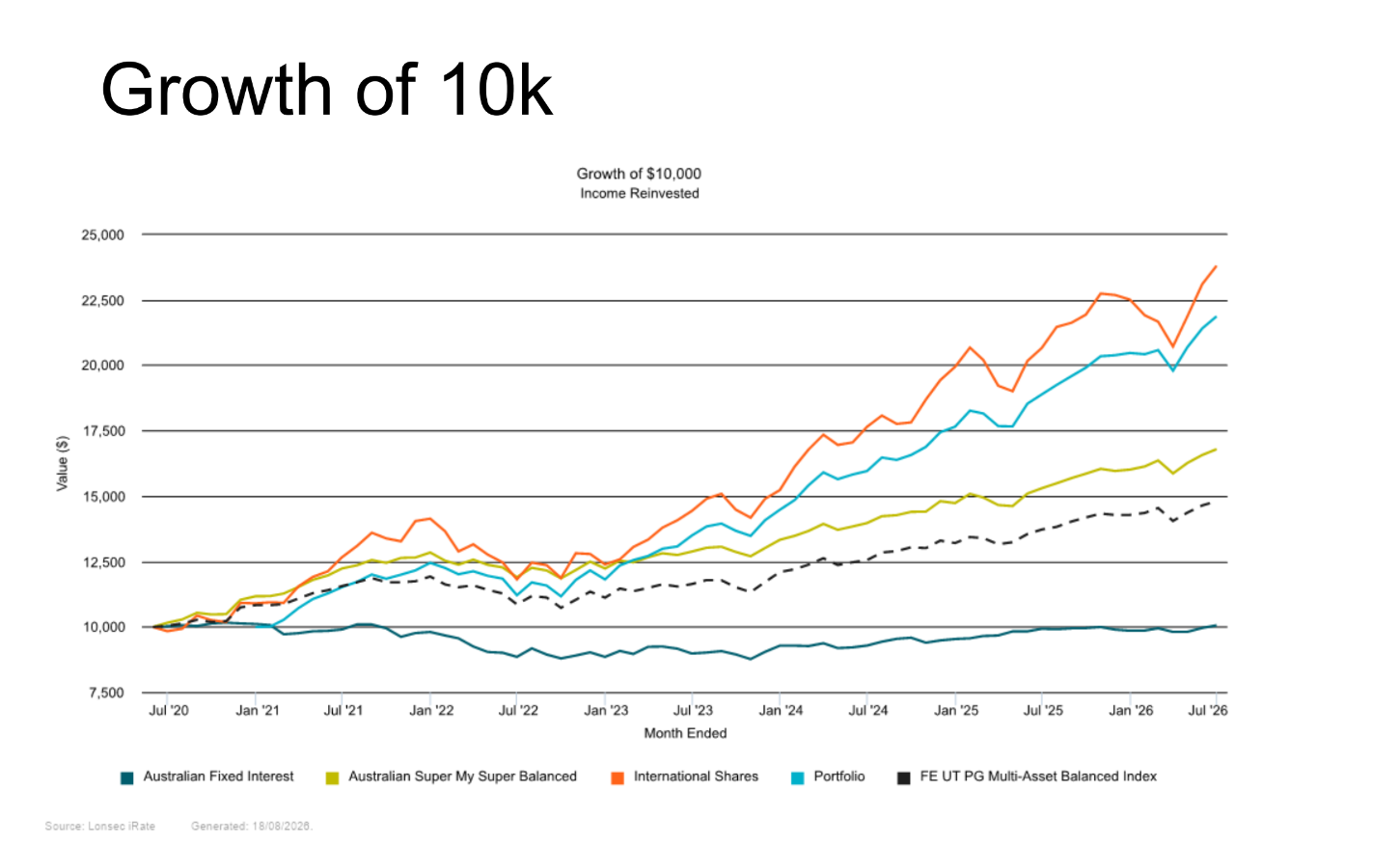
Now look at the falls.
The diversified portfolio (the blue line) still moved up and down, but its largest fall was about 10.5%. International shares fell about 16.7% at their lowest point.
Because the diversified portfolio fell less, it had less ground to make up when markets recovered. Over five years, it also produced a slightly higher annual return than international shares.
That didn’t happen simply because the portfolio held more investments. The benefit came from combining assets that responded differently as markets changed.
When one part struggled, another helped soften the impact.
That’s diversification at work. It can’t prevent every fall, but it can reduce how much one market affects the whole portfolio.
The right mix depends on what you need your money to do, when you’ll need it and how much movement you can handle along the way.
Diversification: giving your money more than one way to work
In simple terms, diversification gives your money more than one way to grow, produce income and support you.
You can spread your investments across:
- Shares, bonds, cash and property
- Different companies and industries
- Australian and international markets
- Different currencies
- Several sources of income
The right mix will look different for each person.
Someone building wealth in their forties may invest differently from someone who plans to retire next year. A business owner whose income already depends on the Australian economy may need a different mix from an employee with secure income and no property investments.
Each part of the portfolio should have a reason for being there.
Shares may provide long-term growth. Bonds may provide income and help reduce some of the movement in a portfolio. Cash gives you access to money without forcing you to sell a long-term investment. Property may provide income and growth, but it takes time and money to sell.
These assets won’t behave the same way in every set of market conditions. This is key. It means when there economic impacts, parts of your portfolio are designed to soften the impact and the size of the downturn.
ASIC’s Moneysmart guide to diversification explains that spreading money across asset types, sectors and countries can reduce a portfolio’s overall volatility because different investments tend to perform well at different times.
Diversification can’t stop a portfolio from falling. During a large market shock, several types of investments can decline at once.
It can, however, reduce the influence that one company, industry, country or economic event has over your whole position.
So, how diversified are you?
A good place to start is by looking at your full financial position, not each investment on its own.
That includes your super, shares, cash, property, business and income. Then look at what sits underneath them.
Are the same companies appearing in several funds? Does much of your wealth depend on Australian property or the local economy? Could one event affect several parts of your position at once?
It’s important to check in that you have an investment mix that suits your goals, gives you access to money when you need it and doesn’t leave too much riding on one result.
If you’re unsure where your risks sit, we can review your full financial position and help you understand whether each investment is doing the job you need it to do.
The Antipodean difference
Our role is not to predict which asset class will lead every year. It is to build and maintain a portfolio in which every allocation has a clear purpose. We seek to capture enough growth to meet long-term objectives while managing the concentration, liquidity and drawdown risks that can derail an otherwise sound strategy.
Diversification will not ensure a profit or prevent a loss. What it can do is improve the structure of the investment journey – giving clients a portfolio designed to participate in growth, withstand a wider range of outcomes and remain investable through difficult markets.